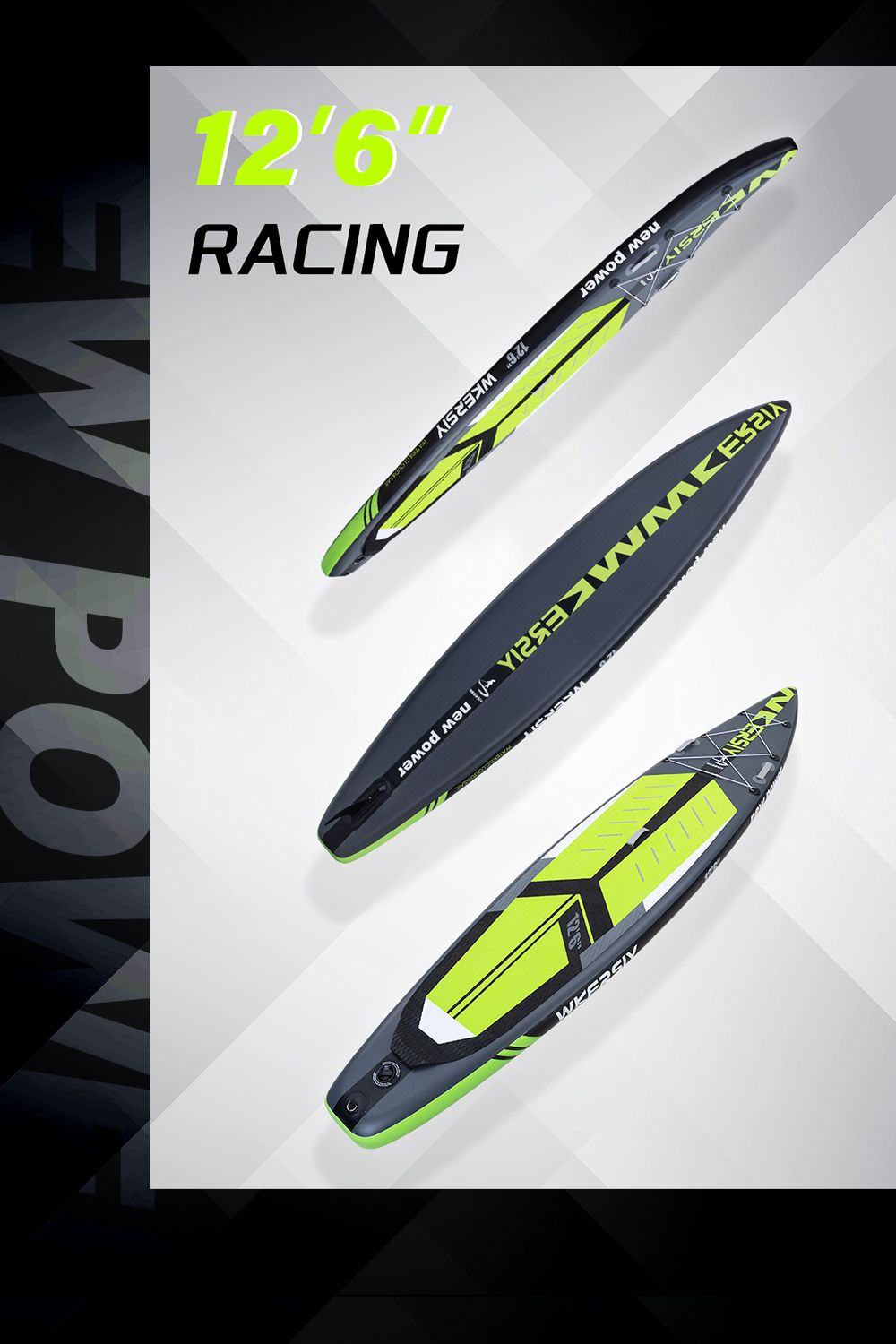
The Glide Ratio Myth: Why Ultra-Light SUPs Destroy Your Momentum
The industry has been selling you a lie, and you have been paying a premium for it. For the last decade, the ultimate metric for a "professional" racing board has been weight. Manufacturers boast about 20-pound, 14-foot carbon hulls, and athletes empty their wallets for the lightest possible platform. But if you take that feather-light board onto a flat-water course, a strange thing happens: it feels incredibly fast to accelerate, but the second you stop paddling, it stops moving. You have to paddle continuously, frantically, just to maintain speed. You have become a victim of the Ultra-Light Paradox, a fundamental misunderstanding of inertial glide.
Section 1: Acceleration vs. Momentum
Physics dictates that Force equals Mass times Acceleration (F=ma). It is absolutely true that a lighter board is easier to accelerate from a dead stop. But SUP racing is not a drag race from a standstill; it is an endurance event of continuous motion. Once you reach hull speed, the game changes from acceleration to momentum preservation.
Momentum is Mass times Velocity (p=mv). If your board has almost no mass, it has virtually no momentum. When you take a stroke, the board surges forward. The millisecond your paddle leaves the water for the recovery phase, the friction of the water instantly acts upon the hull. Without sufficient mass to carry kinetic energy forward (inertia), the lightweight board decelerates violently. You are forced to start your next stroke from a slower speed, meaning you have to re-accelerate the board thousands of times over the course of a race.
Section 2: The Science of Inertial Glide
At RockerWave, we do not chase the lowest number on the scale; we chase the highest Glide Ratio. We engineer our Master Series hulls to possess a specific, calculated mass. We use high-density autoclave carbon to ensure the board is incredibly stiff, but we distribute strategic weight within the stringer system. This is what we call "Kinetic Ballasting."
When you power a RockerWave hull up to race speed, that engineered mass acts like a flywheel. During the recovery phase of your stroke, the board’s inertia powers through the water friction. The board does not stall. It glides. You maintain a significantly higher baseline velocity between strokes. This allows you to lower your cadence slightly, breathe deeper, and let the board do the work.
Section 3: The Energy Expenditure Equation
Let’s look at the physiological cost. Paddling an ultra-light board is like riding a bicycle in too low of a gear; you are spinning your legs frantically just to keep moving. Paddling a board with proper inertial glide is like shifting into high gear on a flat road—every pedal stroke yields massive, sustained distance. By preserving momentum, a RockerWave hull reduces the peak wattage required for every single stroke. Over a 15-mile race, this energy savings translates directly into a devastating final sprint.
Section 4: Stop Buying Air
A board that is purely light is a board that lacks engineering depth. Structural integrity and kinetic momentum should never be sacrificed on the altar of marketing buzzwords. If your current board stalls the moment you stop pulling, it is time to rethink your relationship with weight.
Master the glide. Understand how RockerWave balances mass, stiffness, and momentum for elite racing speeds at RockerWave.com.